ข้อมูลทรัพยากร
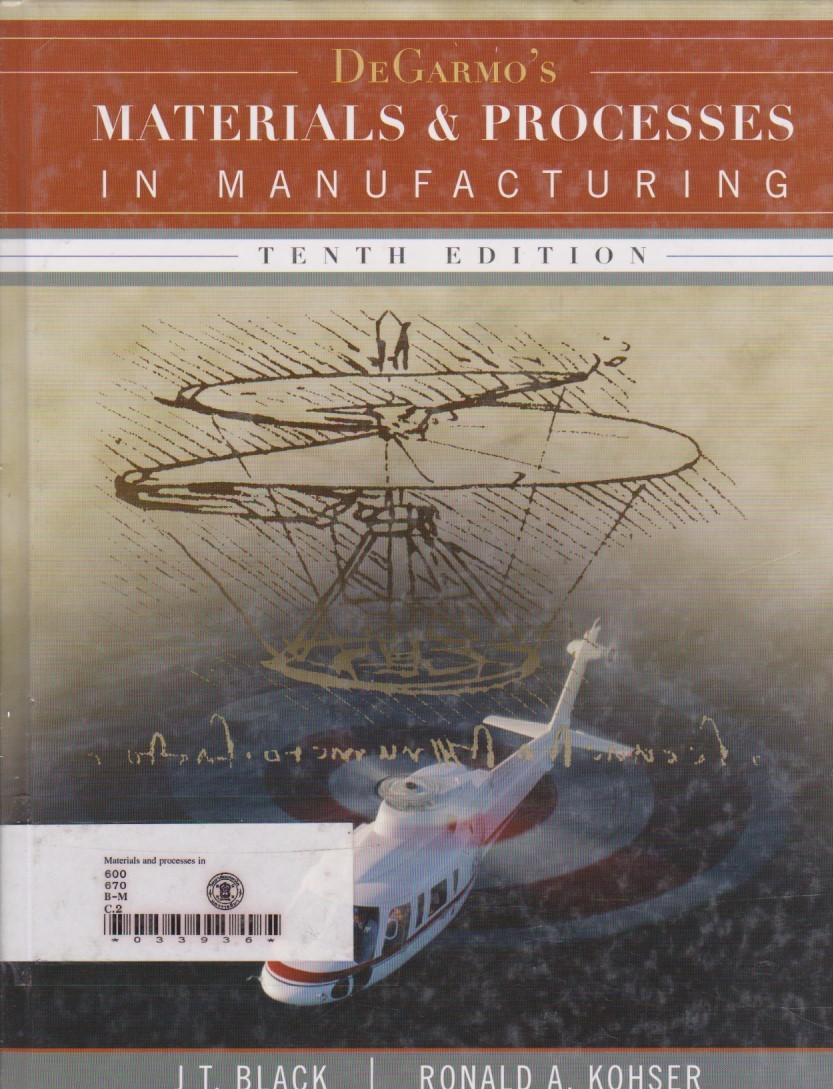
Materials and processes in manufacturing.
ประเภททรัพยากร : หนังสือเล่ม
ชั้นเก็บ : ตู้10 ชั้น 5 ฝั่งขวา
หมวด : 600
เลขหมู่หนังสือ : 670
สำนักพิมพ์ : John Wiley 4 Sons.
ผู้แต่ง : Black, J.T.
ยอดคงเหลือ : 2
เนื้อหาย่อ : nails), transportation (trucks, rails, and rolling stock for railroads), and consumer products
(automobiles and appliances).
Cast iron is an alloy of iron and carbon (2% t0 4%) used in casting (primarily sand
casting). Silicon is also present in the alloy (in amounts from 0.5% to 3%), and other
elements are often added also, to obtain desirable properties in the cast part. Cast iron is
available in several different forms, of which gray cast iron is the most common; its
applications include blocks and heads for internal combustion engines
Nonferrous Metals Nonferrous metals include the other metallic elements and their
alloys In almost all cases, the alloys are more important commercially than the pure metals.
The nonferrous metals include the pure metals and alloys of aluminum, copper, gold,
magnesium. nickel, silver, tin, titanium.zinc. and other metals.
A ceramic is delined as a compound containing metallic (or semimetallic) and nonmetallic
elements. Typical nonmetallic elements are oxygen, nitrogen, and carbon. Ceramics include a
variety of traditional and modern materials. Traditional ceramics, some of which have been
used for thousands of years include: clay (abundantly available, consisting of fine particles of
hydrous aluminum silicates and other minerals used in making brick, tile, and pottery); silica
(the basis for nearly all glass products); and alumina and silicon carbide (two abrasive
materials used in grinding). Modern ceramics include some of the preceding materials such as
alumina, whose properties are enhanced in various ways through modern processing methods
Newer ceramics include: carbides-metal carbides such as tungsten carbide and titanium
carbide, which are widely used as cutting tool matcrials: and nitrides- metal and semimetal
nitrides such as titanium nitride and boron nitride, used as cutting tools and grinding abrasives.
For processing purposes, ceramics can be divided into crystalline ceramics and glasses.
Different methods of manufacturing are required for the two types Crystalline ceramics are
formed in various ways from powders and then fired (heated to a temperature below the
melting point to achieve bonding between the powders). The glass ceramics (namely, glass)
can be melted and casl, and then formed in processes such as traditional glass blowing.
A polymer is a compound formed of repeating structural units called mers, whose atoms
share clectrons to form very large molecules. Polymers usually consist of carbon plus one
or more other elements, such as hydrogen, nitrogen, oxygen, and chlorine. Polymers arc
divided into three categories: (1) thermoplastic polymers, (2) thermosetting polymers.
and (3) clastomers.
Thermoplastic polymers can be subjected to multiple heating and cooling cycles
without substantially altering the molecular structure of the polymer. Common thermo-
plastics include polyethylene, polystyrene, polyvinyIchloride, and nylon. Thermosetting
polymers chemically transform (cure) into a rigid structure on cooling from a heated
plastic condition; hence the name thermosetting. Members of this type include phenolics.
amino resins, and epoxies. Although the name thermosctting is used, some of these
polymers cure by mechanisms other than heating. Elastomers are polymers that exhibit
significant elastic behavior: hence the name clastomer. They include natural rubber.
neoprene, silicone, and polyurethane.
Composites do not really constitute a separate category of materials; they are mixtures of the
other three types. A composite is a material consisting of two or more phases that are