ข้อมูลทรัพยากร
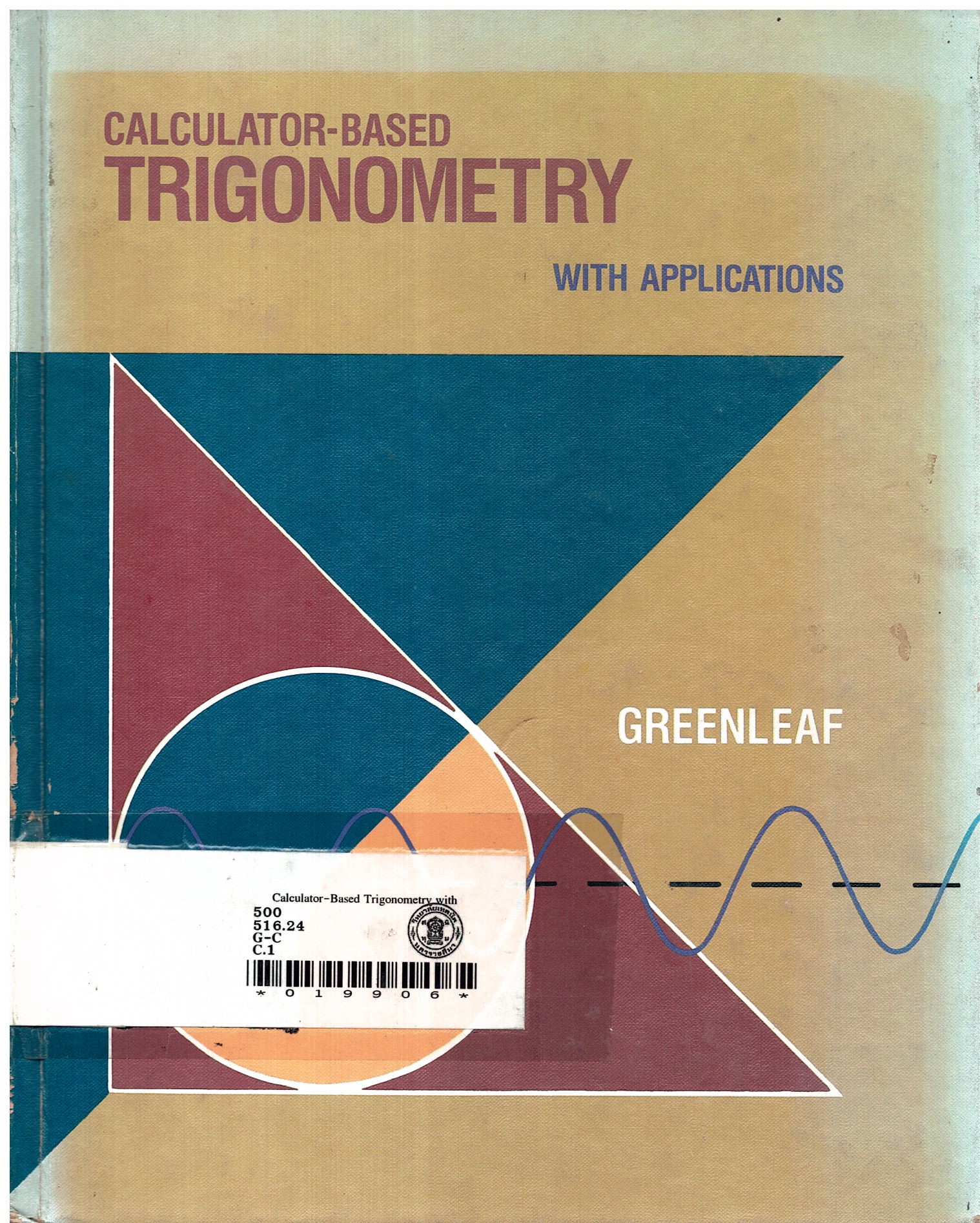
Calculator-Based Trigonometry with Applications.
ประเภททรัพยากร : หนังสือเล่ม
ชั้นเก็บ : ตู้ 9 ชั้น 4 ฝั่งขวา
หมวด : 500
เลขหมู่หนังสือ : 516.24
สำนักพิมพ์ : Book/Cole Publishing Company.
ผู้แต่ง : Greenleaf, Newconb.
ยอดคงเหลือ : 1
เนื้อหาย่อ : More than 2,000 years ago astronomers began to make tables of num-
bers to be used in computing the positions of the sun, moon, and
planets, and in making astronomical and astrological predictions. These
tables were the precursors of modern tables of trigonometric functions,
which were, until recently, the primary tool for making trigonometric
computations. Trigonometry developed as the science of solving trian-
gles, of determining all of the sides and angles when some of them are
given or measured. Trigonometric methods were increasingly applied
in surveying, navigation, architecture, engineering, and physics, as
well as in astronomy. They are all the more useful today because the
necessary computations can be made quickly and easily with a hand-
held scientific calculator. This subject is known as classical trigonome-
try and is covered in the first part of this book, Chapters 1-3.
About three hundred years ago the English mathematician and sci-
entist Sir Isaac Newton (1642-1727) developed the calculus. This
achievement is often considered the biggest "breakthrough" in the his-
tory of mathematics. Since then, mathematicians have combined the
techniques of trigonometry and calculus to study periodic (repeating)
phenomena such as vibrations and waves. This aspect of trigonometry,
known as analytic trigonometry, forms the basis for the mathematics
of sound, light, heat, and fluids, and now provides an indispensable
background for the study of calculus. Analytic trigonometry, based on
circles rather than on triangles, is covered in the second part of this
text, Chapters 4-6.
Both classical and analytic trigonometry are used in many places in
science and higher mathematics. Both should be studied, and it is pos-
sible to start with either area. There are advantages to each approach.
In beginning with classical trigonometry, I follow the sound pedagog-
ical principle of moving from the more concrete to the more abstract.