ข้อมูลทรัพยากร
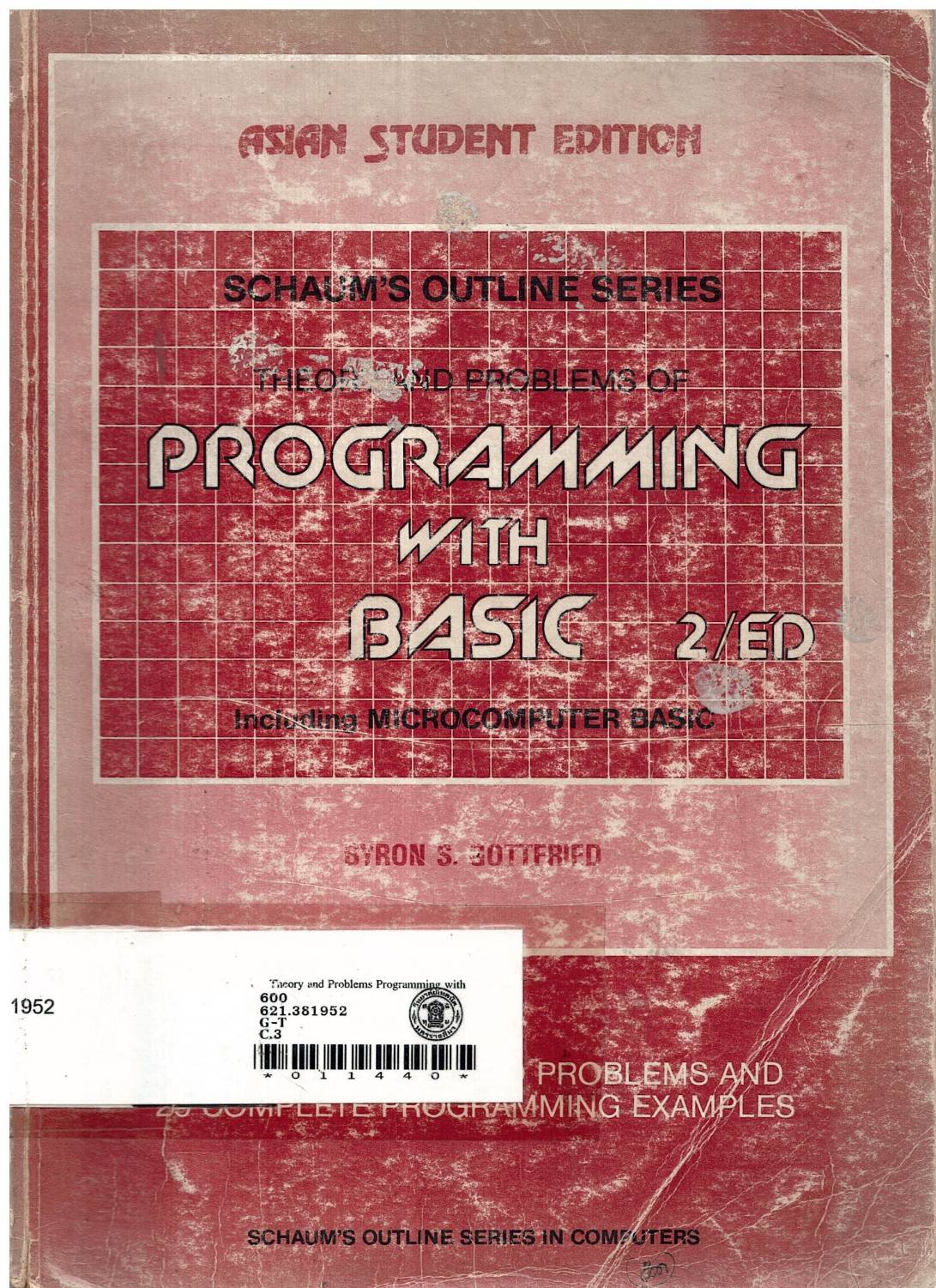
Theory and Problems Programming with Basic, Including Microcomputer Basic.
ประเภททรัพยากร : หนังสือเล่ม
ชั้นเก็บ : ตู้ 9 ชั้น 5 ฝั่งซ้าย
หมวด : 600
เลขหมู่หนังสือ : 621.381952
สำนักพิมพ์ : Mc Graw-Hill.
ผู้แต่ง : Gottfried, Byron S.
ยอดคงเหลือ : 1
เนื้อหาย่อ : Of the many programming languages that are currently in common use, none is easier to
leam or to use than BASIC. Yet this remarkably simple language contains enough power and
versatility to be used by many different people for a wide variety of applications. Consequently,
BASIC programming courses have become common in many high schools and junior high
schools as well as most colleges and universities. Even elementary schools now offer introduc-
tory BASIC courses to select groups of students!
Another reason for BASIC's popularity is its widespread availability. The language is now
available on practically every large computer, and it is supported by virtually all commercial
timesharing services. Moreover, in recent years BASIC has become the standard language for
most microcomputer applications. Hence the language can be used on both large and small
computers, in all types of different programming environments.
This book offers instruction in computer programming using the standard features of
BASIC. All the principal features of BASIC are discussed. In addition, the book stresses the
development of programs that are logical, efficient and orderly. Thus, the reader is exposed to
the principles of good programming practice as well as the specific rules of BASIC.
The style of writing is deliberately elementary. This enables the book to be easily under-
stood by a wide reader audience, ranging from high school students to practicing professionals.
The book is particularly well suited to the advanced secondary or beginning college level, either
as a textbook for an elementary programming course, as a supplementary text for a more
comprehensive course in anal ytical techniques or as an effective self-study guide. For the most
part, the required mathematical level does not go beyond high school algebra.
The text is organized into two parts of about equal length. Part I, "Basic BASIC,"' con-
tains the commonly used features of the language. A brief programming course can be taught
from this material alone. Part II, "'Advanced BASIC," is concerned with more specialized
features, such as subroutines, matrix statements and file manipulation. The book concludes
with a chapter on enhanced BASIC, with particular emphasis on microcomputer implementa-
tions.
The material is presented in such a manner that the reader can write complete, though
elementary, BASIC programs as soon as possible. It is very important that the reader write
such programs and run them on a computer concurrently with reading the text. This greatly
enhances the beginning programmer's self-confidence and stimulates his or her interest in the
subject. (Learning to program a computer is like learning to play the drums: it cannot be learned
simply by studying a textbook!)
A large number of examples are included as an integral part of the text. These include a
number of comprehensive programming problems as well as the customary drill type of exer-
cises. In addition, a set of solved problems is included at the end of most chapters. These
examples and solved problems should be studied carefully as the reader progresses through
each chapter and begins to write his or her own programs.