ข้อมูลทรัพยากร
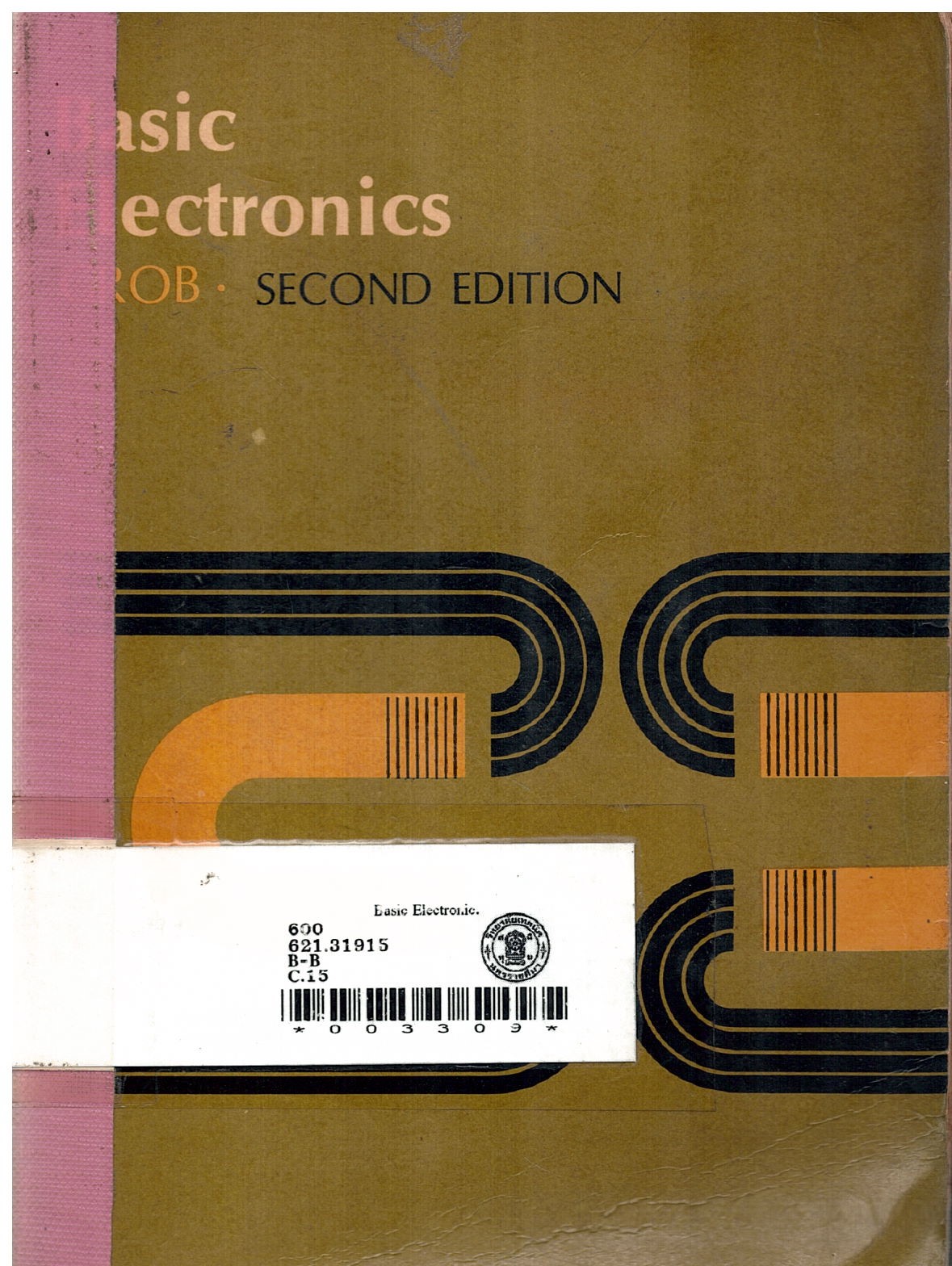
Basic Electronic.
ประเภททรัพยากร : หนังสือเล่ม
ชั้นเก็บ : ตู้ 9 ชั้น 2 ฝั่งซ้าย
หมวด : 600
เลขหมู่หนังสือ : 621.31915
สำนักพิมพ์ : Mc Graw-Hill.
ผู้แต่ง : Bernard, Grob.
ยอดคงเหลือ : 15
เนื้อหาย่อ : This basic text is for beginning students without any previous experience
in electricity or electronics. It presents the necessary information for intro-
ductory technical training in electrical principles, vacuum tubes, and
transistors needed for all electronic circuits. Starting with electrons and
the atom, the topics progress to d-c circuits, magnetism, a-c circuits,
vacuum tubes, and transistors. These fundamentals form the basis for the
study of advanced applications, including communications electronics
such as radio and television, industrial electronics, and computers.
The order of topics is based on the author's experience in teaching the
technician's course in Electronics Fundamentals at RCA Institutes. For
each subject, the basic principles are explained first, followed by typical
applications and common troubles. This presentation has proved effective
in helping students learn the fundamentals of electronics with a practical
approach that is both interesting and useful for technicians and servicemen.
Summary of contents. As in the first edition, the book is organized into
twenty-five chapters. This step-by-step development and thorough analysis
of main subjects is very effective in helping the students to learn. For
example, separate chapters on series circuits and parallel circuits build up
to more advanced series-parallel circuits and networks. Similarly, there are
separate chapters on inductance and inductive reactance before combining
these fundamentals for inductive circuits. The same sequential develop-
ent is used for capacitive circuits. Then all the principles are combined
for a-c circuits and resonance. The same approach is used within the
chapters. The sequential method, similar to programmed learning, is par-
cularly helpful in Chapter 21, Complex Numbers, where the operations
developed in small steps, with a problem to illustrate each point. The
thematics needed for the problems illustrating the theoretical principles
explained in Appendix E, which includes simple trigonometry and
wers of ten.