ข้อมูลทรัพยากร
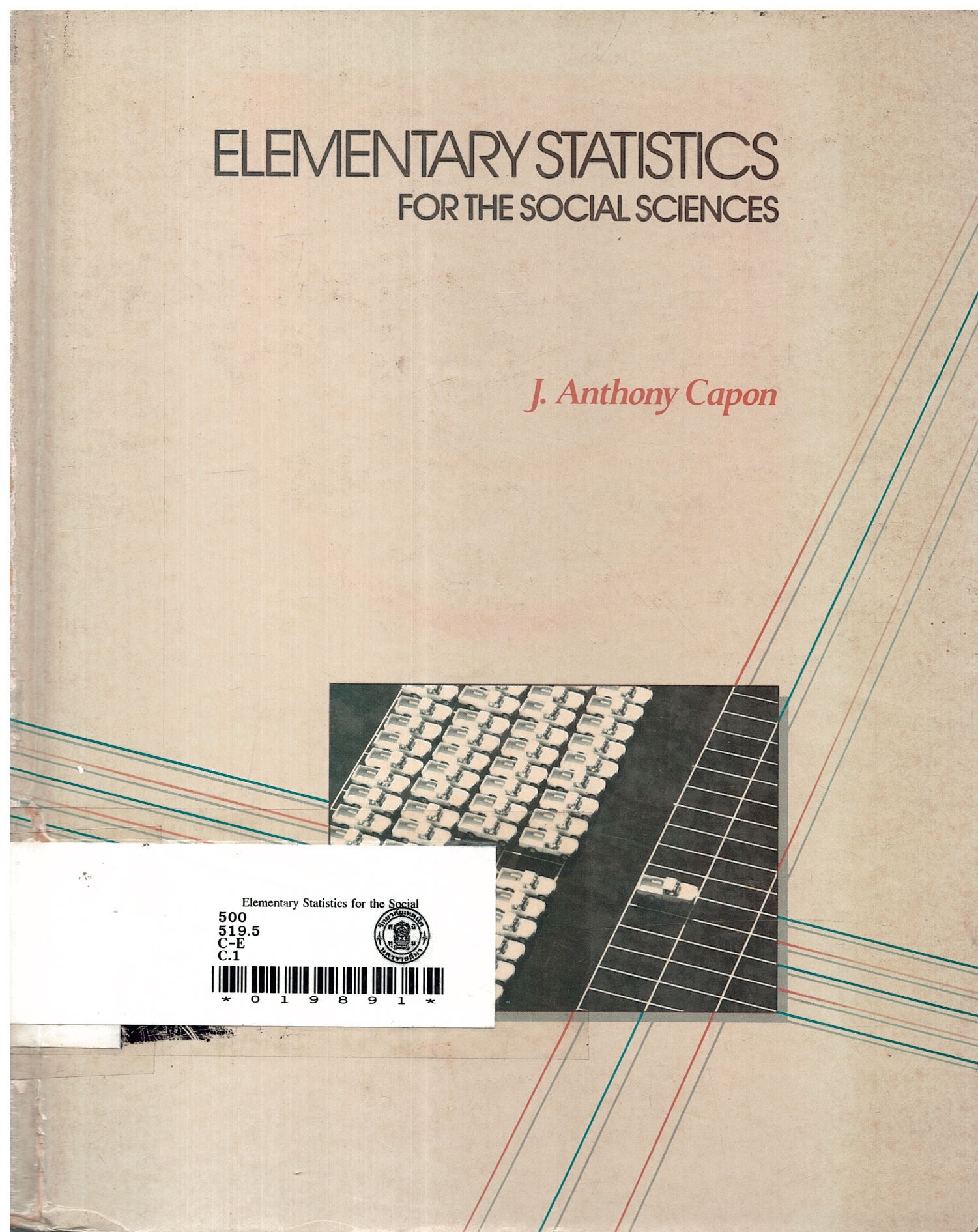
Elementary Statistics for the Social Sciences.
ประเภททรัพยากร : หนังสือเล่ม
ชั้นเก็บ : ตู้ 9 ชั้น 4 ฝั่งขวา
หมวด : 500
เลขหมู่หนังสือ : 519.5
สำนักพิมพ์ : Wadsworth Publishing Company.
ผู้แต่ง : Capon, J. Anthony.
ยอดคงเหลือ : 1
เนื้อหาย่อ : ELEMENTARY STATISTICS FOR THE SOCIAL SCIENCES is the result of many years
of teaching statistics to undergraduates in the social sciences, including anthro-
pology, geography, history, political science, and sociology, as well as under-
duates in social work, education, and some health related areas. I
a number of texts and found myself continually searching for one that would
cover the important aspects of statistics at a level appropriate for students with
limited math backgrounds, for students who would never take another statistics
course, and for students who would need to be adequately prepared for statistics
courses at the graduate level.
No one- or two-semester course will make statisticians out of undergraduate
students. Reasonable goals for a first course in statistics include giving the stu-
dents the background necessary to be intelligent consumers of statistical infor-
mation and preparing them for either an advanced undergraduate course or a
first graduate course in statistics. This text is lower-intermediate in levelㅡ-above
the "cookbook'' approach in comprehensiveness but below some excellent texts
that are often too mathematical for many undergraduates taking a first course in
statistics. It presupposes no math background beyond a high school algebra
course and presupposes no knowledge of statistics whatsoever. For students
who feel that their math background is weak, Appendix A (A Review of Basic
Mathematical Skills) will be useful.
Students need not be able to derive statistical formulae mathematically in
order to understand the logic underlying statistical procedures. Therefore, I have
emphasized the logical and intuitive understanding of statistical theory and have
avoided all but the most elementary mathematical derivations. Examples used
to illustrate statistical procedures have purposely been kept simple and straight-
forward so that the students' focus will be on the procedures themselves rather
than on the math.