ข้อมูลทรัพยากร
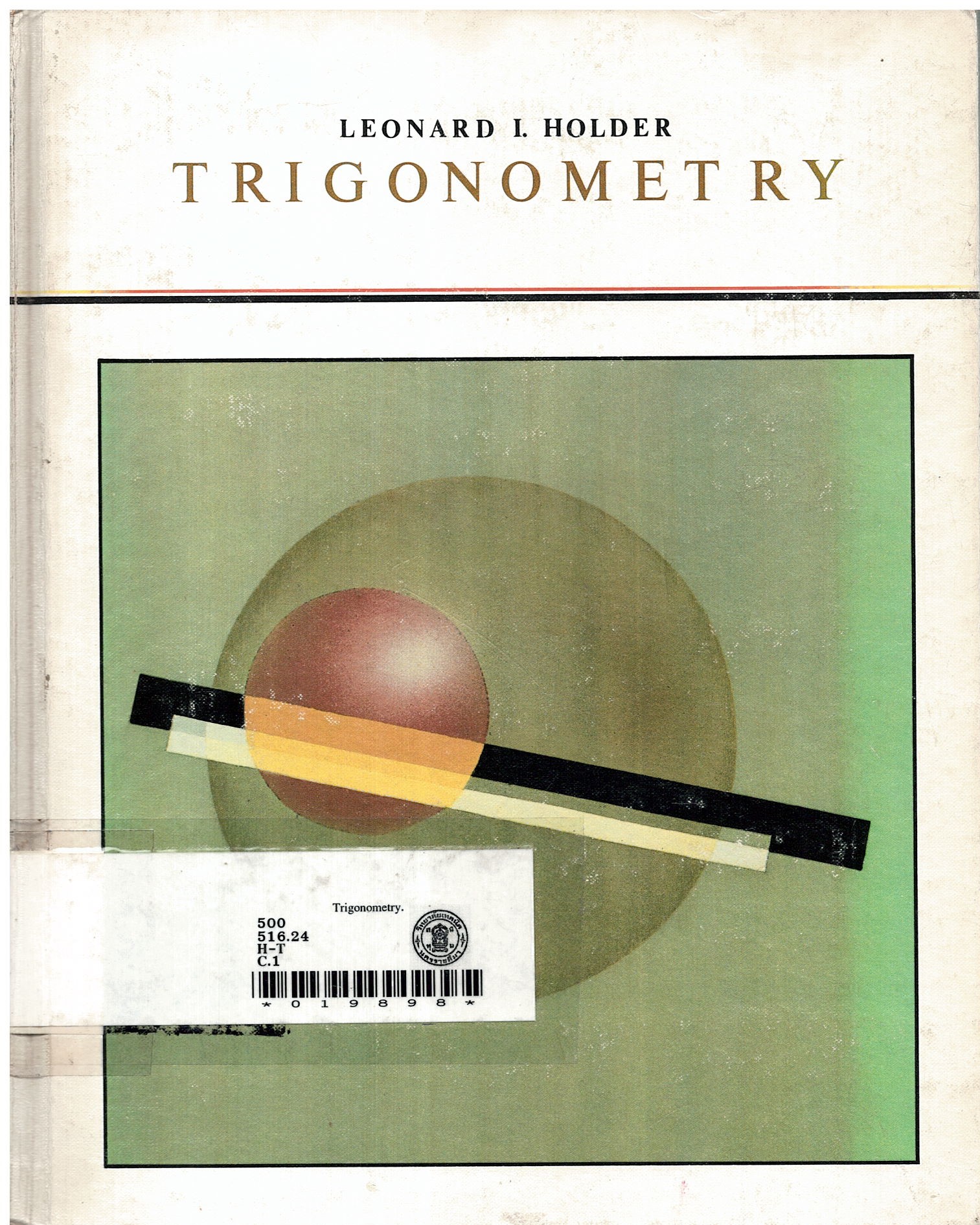
Trigonometry.
ประเภททรัพยากร : หนังสือเล่ม
ชั้นเก็บ : ตู้ 9 ชั้น 4 ฝั่งขวา
หมวด : 500
เลขหมู่หนังสือ : 516.24
สำนักพิมพ์ : Wadsworth Publishing Company.
ผู้แต่ง : Holder, Leonard Irvin.
ยอดคงเหลือ : 1
เนื้อหาย่อ : Trigonometry is written as a college-level text to provide a basis for future work in
mathematics and its applications. For students planning to take calculus, chemistry,
engineering, or physics the material covered is essential.
I have avoided a formal "theorem-proof" style of writing and have instead used
a more conversational approach because I believe this makes the book more readable
for students. Nevertheless, the book is mathematically sound, and certain proofs
appropriate to the level of mathematical maturity of the users are given. Many
worked-out examples are included, illustrating the main types of problems in the
exercise sets. The exercise sets are divided into A and B problems, with the more
challenging problems to be found in the B category. There are numerous drill-type
problems in the A exercises designed to fix concepts and provide practice in the
technique being studied.
Each chapter is introduced by an example taken from a textbook in a field which
employs trigonometry. The example illustrates an application of one or more of the
concepts to be studied in the chapter. Students are not expected to follow the details
of these introductory examples but simply to observe the application of trig-
onometry. The examples thus serve as motivational devices, showing the student
that what they will be studying has immediate application in an area they may well
be pursuing.
I have introduced numerical trigonometry before analytical trigonometry because
I believe this provides greater motivation for students and is pedagogically the
sounder approach. The trigonometric functions are introduced first in terms of right
triangles, then for general angles, and finally as functions of real numbers. The
solution of right triangles is taken up in Chapter 2, after which the analytical aspects
of the subject are studied in Chapters 3 and 4. Chapters 5 and 6 on logarithms and
the solution of oblique triangles could follow Chapter 2 if the instructor prefers this
order. I have used the order given so as to avoid too great a delay in introducing
analytical trigonometry. The concluding chapter on complex numbers brings out the
beautiful relationships this subject provides between algebra, geometry, and trig-
onometry.
The advent of hand calculators and their widespread availability at moderate
prices have had a dramatic impact on the computational aspects of many courses,
and this is particularly true in trigonometry. Lengthy computations involving trig-