ข้อมูลทรัพยากร
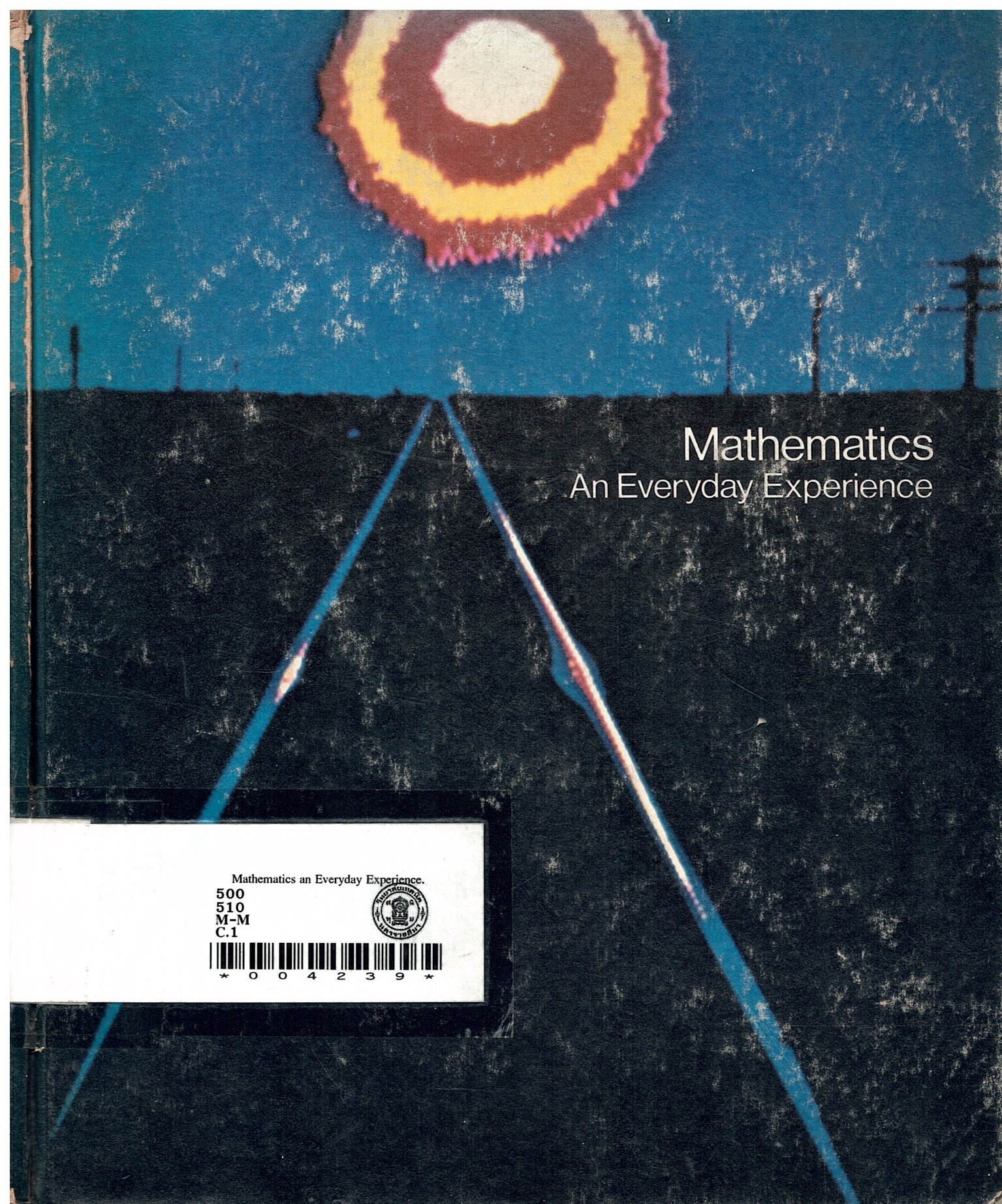
Mathematics an Everyday Experience.
ประเภททรัพยากร : หนังสือเล่ม
ชั้นเก็บ : ตู้ 9 ชั้น 3 ฝั่งขวา
หมวด : 500
เลขหมู่หนังสือ : 510
สำนักพิมพ์ : Scott, Foreman and Company.
ผู้แต่ง : Miller, Charles D.
ยอดคงเหลือ : 1
เนื้อหาย่อ : Mathematics: An Everyday Experience is about mathematics-real, in-
teresting, and useful mathematics. This book gives students a feel for
some of the main areas of contemporary mathematics, as well as an
appreciation for how mathematics is used-in analyzing energy con-
sumption; in buying a house, a car, or insurance; in advertising; in
business; in architecture; as patterns in nature; and in many other ways.
The only prerequisite is arithmetic. Most of the sections are devel-
oped in the following manner: a new idea is presented, usually by
means of a practical application. This is followed by two to four exercise
sets. These exercise sets develop the idea further, help the student dis-
cover patterns and formulas, and show applications of the mathematics
to other fields.
The problems in the exercise sets have been carefully developed so
that the student is led, step by step, to the desired conclusion. Answers
to about two thirds of the problems are given in the back of the book,
with the answers serving as hints.
This book can be used in regular lecture sections, large sections,
or for individualized instruction. In addition it can be used in a variety of
courses, including mathematics for liberal arts students, general math-
ematics, mathematics for elementary teachers, and finite mathematics.
Suggested course outlines, as well as suggestions for various types of
teaching, are discussed in more detail in the Instructor's Guide. The
Guide also includes a large number of sample tests and quizzes, an
arithmetic review package, and answers to those problems not an-
swered in the book.
A number of people have contributed to this book, either by giving
suggestions for appropriate topics and applications, or by reviewing the
manuscript. We received special help from Edward Harper of American
River College. We also received significant input from David Fontana
and Margaret Lial of American River College; Raymond Coughlin of
Temple University; Thomas Moore of Bridgewater State College; John
Vadney of Fulton-Montgomery College; Eugene Lipowitz of Community
College of Philadelphia; James Ware of University of Tennessee; Janet
Ray of Seattle Community College; William Andrews of Triton College;
and Don David Argo of Brevard Community College.
Robert Runck, Executive Editor at Scott, Foresman, helped us de-
velop our ideas for the book. The many details involved in editing the
book and arranging the illustrations were taken care of by Pamela
Conaghan and Nat Weintraub.