ข้อมูลทรัพยากร
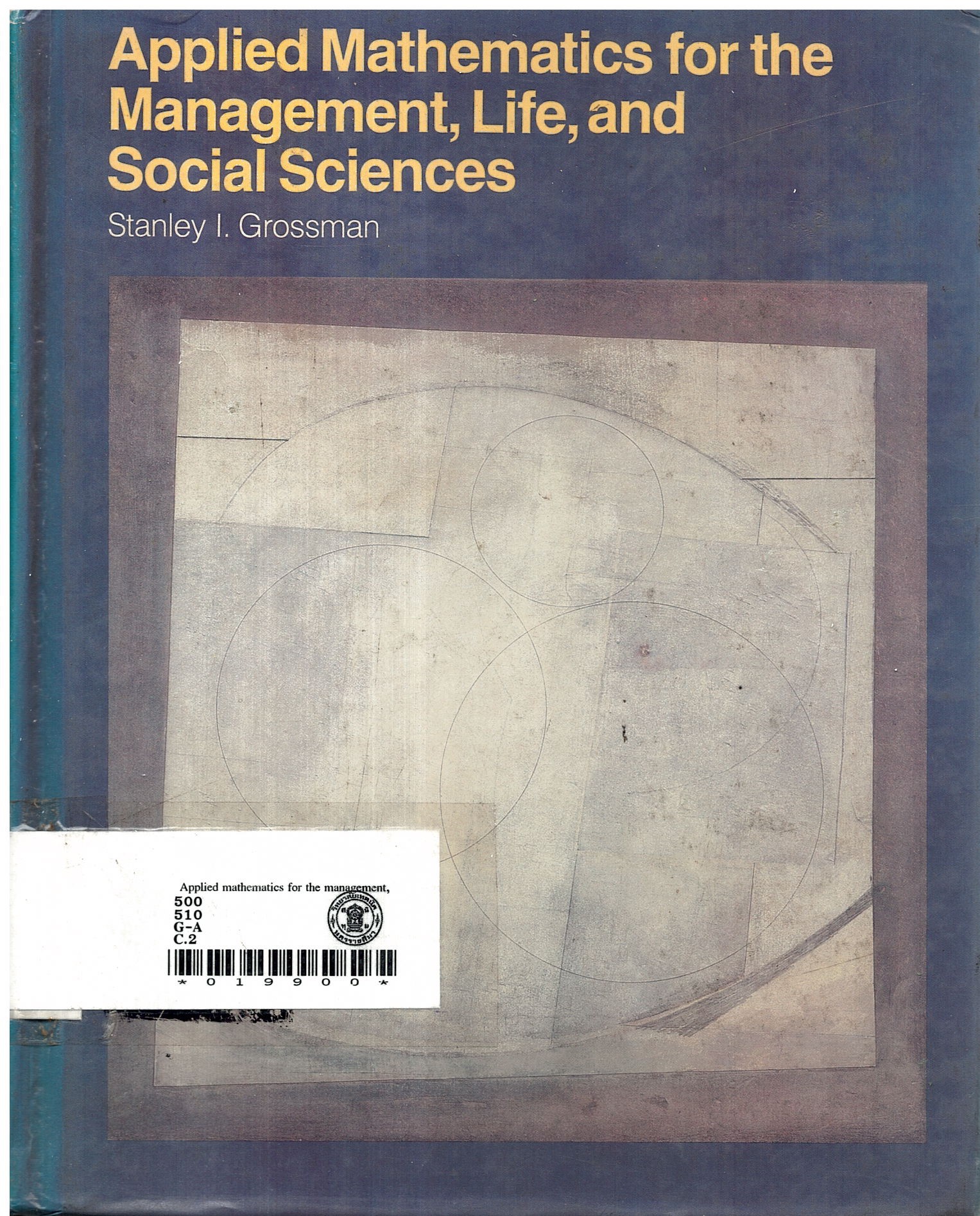
Applied mathematics for the management, life and social sciences.
ประเภททรัพยากร : หนังสือเล่ม
ชั้นเก็บ : ตู้ 9 ชั้น 3 ฝั่งขวา
หมวด : 500
เลขหมู่หนังสือ : 510
สำนักพิมพ์ : A Division of Wadsworth, Inc.
ผู้แต่ง : Grossman, Stanley I.
ยอดคงเหลือ : 1
เนื้อหาย่อ : Students in business and the social and biological sciences require a variety of
mathematical tools for their studies. Applied Mathematics for the Management,
Life, and Social Sciences provides many of these tools. Approximately two-thirds
of the book (Chapters 1-8) covers material commonly gathered under the topic
finite mathematics and can be covered in one semester or two quarters. The remain-
ing five chapters provide an introduction to calculus. These last chapters can be
covered in one quarter or one semester.
Applied Mathematics for the Management, Life, and Social Sciences is an out-
growth of two courses I have taught many times at the University of Montana:
Mathematics for Business and Mathematics for the Biological Sciences. The pre-
requisite for students in these courses is intermediate algebra, and that is the pre-
requisite for this text. However, for those students who need to review some
frequently used topics in algebra, I have provided an appendix that includes detailed
discussions of polynomials, quadratic equations, and rational expressions. This
supplements the preliminary material in Chapter 1.
Some of the features of Applied Mathematics for the Management, Life, and
Social Sciences are:
Examples. As a student, I learned this material from seeing examples and doing
exercises. There are 668 examples--many more than are commonly found in texts
at this level. The examples include all the necessary steps so that students can see
clearly how to get from ''A to B.'' In many instances, explanations are highlighted
in color to make steps easier to follow.
Exercises. The text includes more than 3700 exercises-both drill and applied
problems. More difficult problems are marked with an asterisk (*), and a few
especially difficult ones are marked with two (**). In my opinion, exercises provide
the most important learning tool in any undergraduate mathematics textbook. I
stress to my students that no matter how well they think they understand my lectures