ข้อมูลทรัพยากร
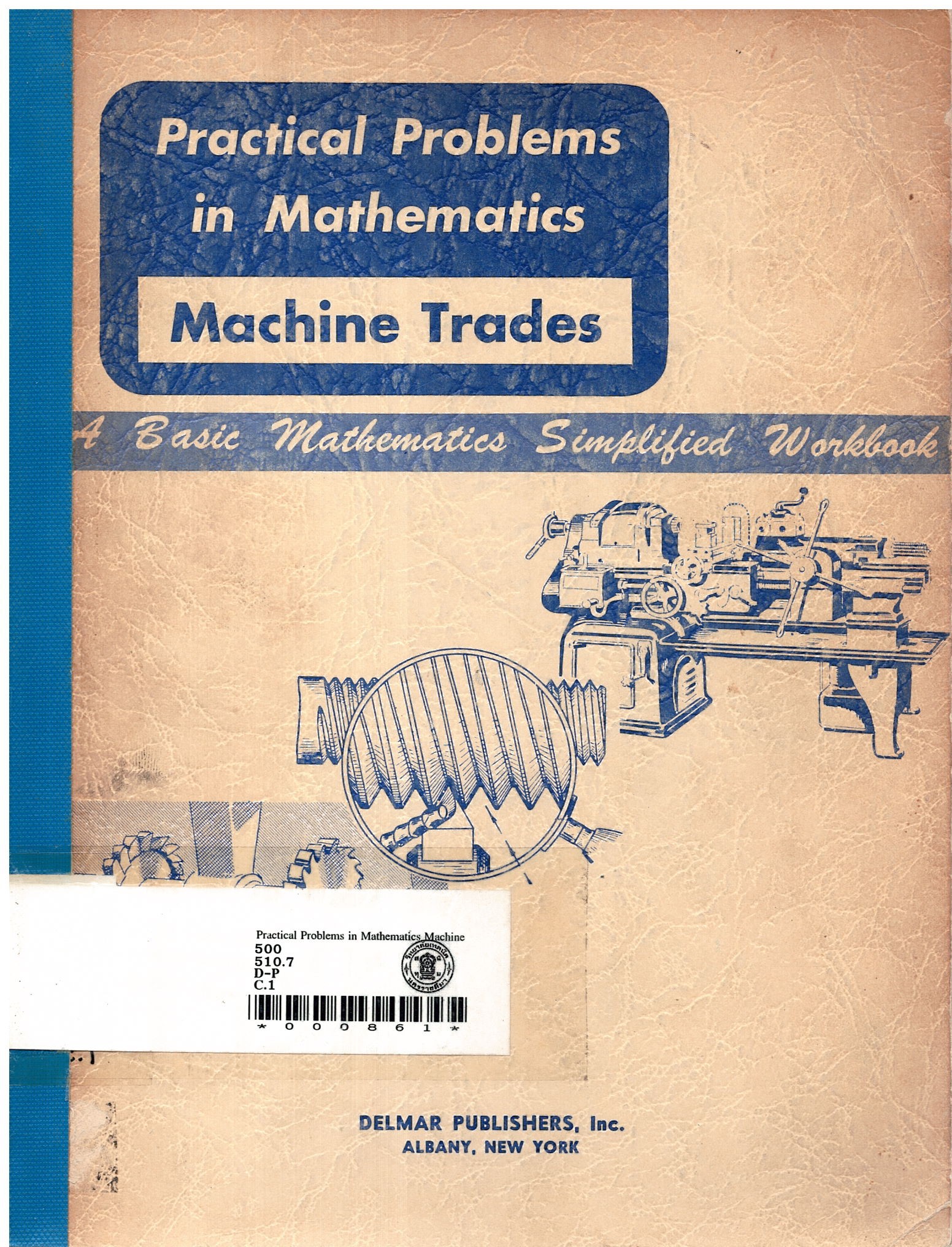
Practical Problems in Mathematics Machine Trades.
ประเภททรัพยากร : หนังสือเล่ม
ชั้นเก็บ : ตู้ 9 ชั้น 3 ฝั่งขวา
หมวด : 500
เลขหมู่หนังสือ : 510.7
สำนักพิมพ์ : Delmar Publishers, Inc.
ผู้แต่ง : Delmar Publishers, Inc.
ยอดคงเหลือ : 10
เนื้อหาย่อ : MATHEMATICS FOR MACHINE TRADES provides practical problem material
for students, craftsmen, technicians and others. In this field, measurements may be
taken and hand and machine operations performed with accuracy and speed when
certain basic mathematical concepts and principles are understood. A working
knowledge of mathematics makes it possible to compute required dimensions and
other essential data which are applied on the job and in everyday living.
Over a period of years, the skills and related technical information required
of craftsmen in a number of trades were analyzed. From these analyses, mathemati-
cal principles and concepts were outlined and representative trade problems were
selected. In developing the problem material in this workbook, no attempt was made
to explain mathematical principles, terms, symbols, how formulas are derived, and the
like, as these are covered in the companion text, BASIC MATHEMATICS SIMPLIFIED.
The trade problems, specially selected to insure mastery of each new principle,
are provided in a series of instructional units which are grouped in blocks of work to
be accomplished and are arranged in the natural order of dependence of one topic on
the next. As the student progresses from unit to unit and block to block, the solution
of each new problem requires an understanding of more advanced and complex mathe-
matical principles and symbols.
Each trainee may not be required to complete all of the problems in a unit or
block because of the number of similar examples which have been provided for drill
purposes. Assignments to trainees should be determined by the amount of repetitive
problem solving required by each individual and exacting local requirements.
Sizes,
Testing material is provided at the end of most blocks of work to make certain
that each type of trade problem is mastered before advancing to the next.
dimensions and values have been omitted from the test problems so that each instruc-
tor may furnish these to provide variation. Wherever possible, each step in the
solution of a problem should be marked with the proper unit of measurement. The
final answer should indicate the unit of measurement followed by the abbreviation
(Ans.). Computations should be checked by using a different method, rechecking the
steps, or by actual measurement. Greater accuracy is assured when these practices
are followed.
The content of the original manual was prepared largely by the Connecticut
Curriculum Committee on Mathematics for the Machine Trades, and others. Credit
for the present revision of the original material is given to Messrs. F. Wesley Sunder-
land, Ralph Toombs, Russell Dobelstein, Harold Gannon, Henry Hill, Joseph Metzger,
Peter Umstatter, Robert Lea, Alexander Fraser and Ernest Rickert.
Special recognition is made for the leadership given in both the initial and final
stages of planning by Richard W. Howes, Assistant Director, Bureau of Vocational
Education, Connecticut State Education Department; to Anna C. Moore, Consultant
O'Brien, and Joseph Nerden, Chief, Trade and Industrial Education; and to Emmet A.
Director of the Division of Vocational Education, for helpful cooperation.